Skip to content


Key facts: Denmark’s world-leading climate action
- Denmark has more than halved its emissions since 1990 and is aiming for an 82% cut by 2035
- Ranked first in the Climate Change Performance Index
- Wind and solar make up over 70% of power output
- Electric models now account for over 70% of new car sales
- Incentive programmes have played a major role in Denmark’s decarbonisation
When the oil crisis of the early 1970s sent shockwaves through the global economy, few countries were in as precarious a position as Denmark. The Nordic nation relied on imported oil for over 90% of its energy needs at the time, meaning the shortages and price spikes sparked by the OPEC embargo were particularly painful.
Yet that state of vulnerability forced Denmark to start developing a more efficient, diversified, and self-sufficient energy system. Decades later, the country of 6 million people is the world leader in decarbonisation – and its transformative journey carries lessons for others at a time when energy security and climate risks are coming to the fore.
Denmark comfortably ranks atop the annual Climate Change Performance Index, an independent monitoring tool compiled by civil society and research groups. The country has more than halved its emissions since 1990 and “is on track” to meet its legally-binding goal of a 70% reduction by 2030, per the European Environment Agency.
That’s partly thanks to the ongoing shift toward 100% renewable electricity – a milestone that’ll likely be realised by the end of this decade, climate minister Lars Aagaard told The Progress Playbook on the sidelines of COP30 in Belém.
At the conference, Aagaard announced that Denmark’s emissions reductions will reach at least 82% by 2035, relative to the 1990 baseline. “We must once again show the rest of the world that it is possible to balance ambitious climate goals with a competitive business sector and social cohesion,” he said.
While the energy system accounts for the bulk of Denmark’s decarbonisation progress to date, the transport sector is also making headway, Aagaard says.
Electric models now account for over 70% of the nation’s new car sales, buoyed by generous tax incentives. And Copenhagen has become ‘the world’s most bicycle-friendly capital city’ thanks to its growing network of dedicated cycling lanes. This has helped the capital reduce its emissions by 42% in about a decade, according to the C40 Cities Climate Leadership Group.
The birth of a wind energy giant
In response to the 1970s oil crisis, Denmark initially focused on curbing energy consumption through efficiency gains. Among other things, the government aggressively expanded district heating networks, which harness heat from power stations and factories to warm urban homes. It also imposed taxes on energy consumption and subsidised investments in building improvements, including in insulation.
Then, to further reduce its reliance on foreign oil and coal, Denmark decided to tap the domestic energy resources it has in abundance – primarily wind.
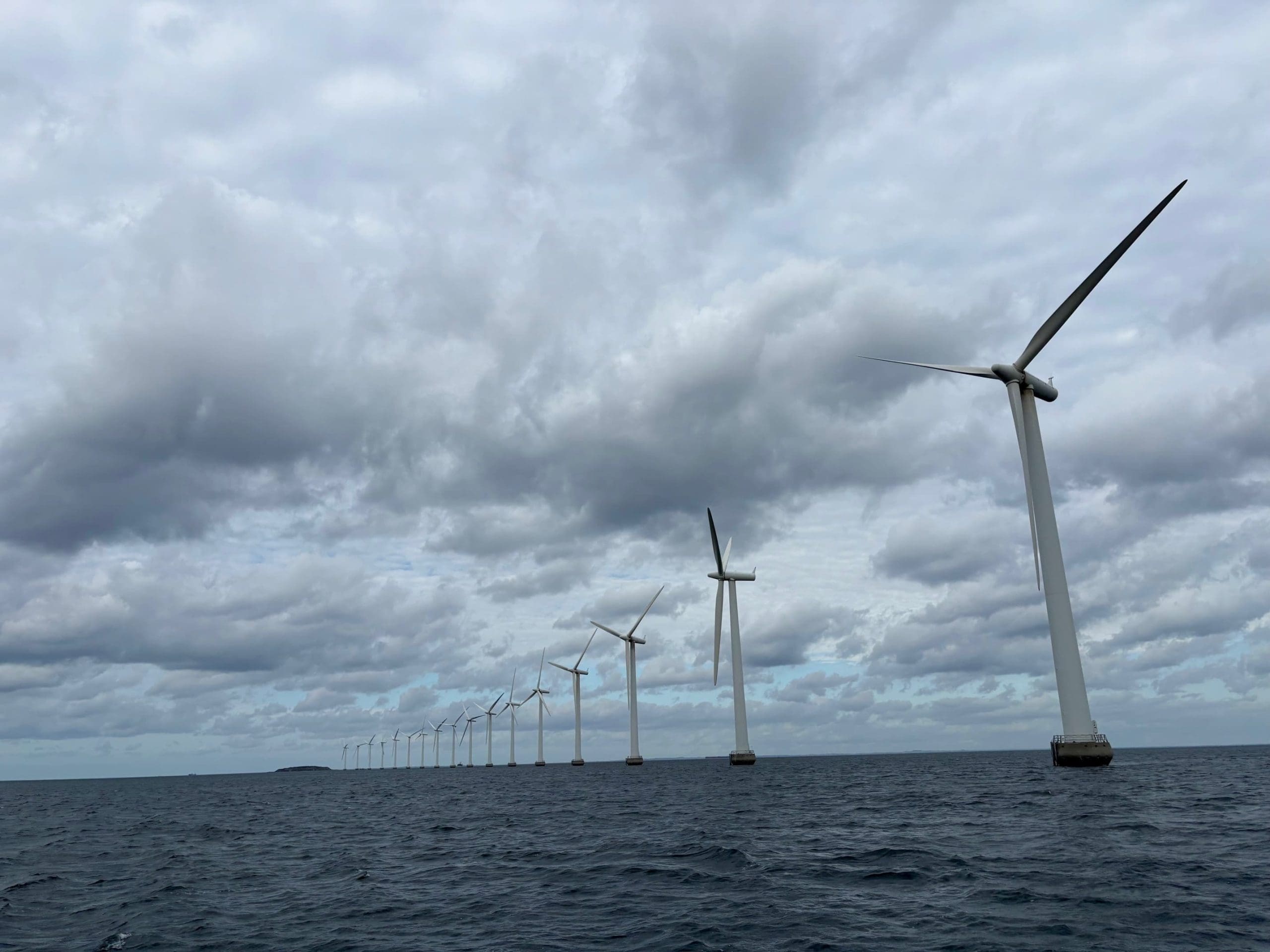
Widely considered the pioneer of modern wind energy – including offshore technologies – the country is now the global leader in integrating variable renewables into its electricity network.
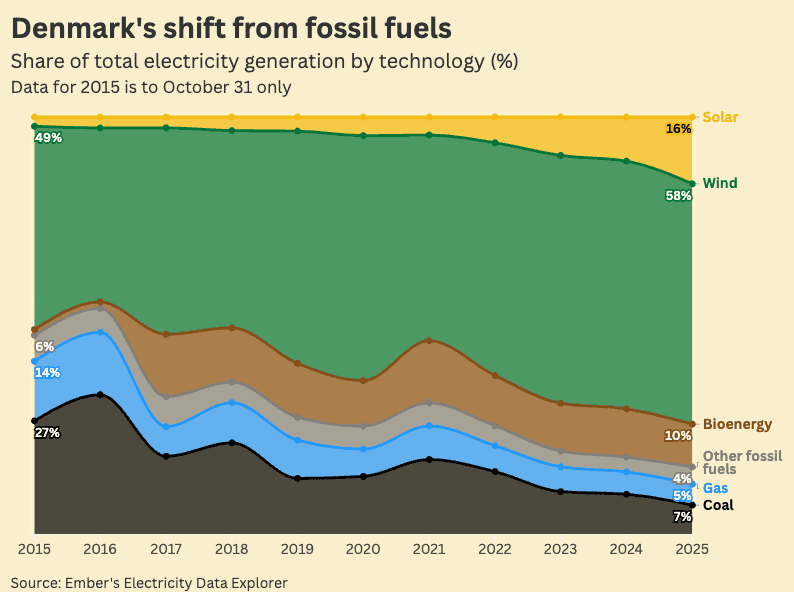
Wind and solar accounted for 74% of the nation’s power output in the first 10 months of 2025, according to data collated by climate and energy research group Ember. That’s more than any other nation (though the International Energy Agency sees Lithuania and Luxembourg moving up to the top of the rankings by 2030, partly because a large-scale Danish offshore wind auction was recently cancelled amid rising costs and supply chain constraints).
Mirroring the nation’s transformation, state-owned energy group Ørsted has morphed from an oil and gas group into a pure-play renewables company, having fully divested of its fossil fuel operations in 2017.
A conducive environment for progress
Incentive programmes – particularly for energy efficiency, renewables and low-carbon transport options – have played a major role in Denmark’s decarbonisation, says Ole Sørensen, a director at the Danish Energy Agency, which falls under the Ministry of Climate, Energy & Utilities.
The government’s efforts to address barriers to investment, such as permitting challenges, have also helped, Sørensen tells The Progress Playbook. Reducing risk is critical to the transition due to the large upfront capital requirements for clean energy projects, he adds.
Rising CO2 prices in the EU Emissions Trading System have also been a key decarbonisation enabler, says Peter Møllgaard, chair of the Danish Council on Climate Change, an independent expert body tasked with advising the government.
Moreover, there’s long been broad political agreement over the country’s energy transition strategy, which has ensured continuity and stability even amid changes in government, Møllgaard says.
Denmark’s decarbonisation policies have also had widespread buy-in partly because the private sector helped draft them.
To devise specific strategies that’ll put the country’s 2030 climate targets within reach, the Danish government asked representatives from 14 industries – including companies, labour unions, and civil society groups – to draw up transition proposals for their sectors.
Among other things, these discussions culminated in the introduction of the world’s first tax on livestock emissions, which is set to be implemented in 2030 as part of a ‘tripartite’ agreement involving the government, farming organisations, and environmental groups.
The deal also includes incentives to reduce the use of nitrogen-based fertilisers, and a commitment to reforest 10% of the country’s total land area – including some farmland. It complements state-led programmes aimed at promoting a shift to plant-based foods.
A leader – but far from perfect
To meet its 2030 goals, Denmark will rely partly on carbon capture and storage (CCS) in the industrial and waste incineration sectors – an immature and costly technology that’s not guaranteed to deliver as promised.
“So, what still needs to be done is the establishment of substantial amounts of CCS, and turning the political agreement on agriculture into woods and nature,” Møllgaard says.
Additionally, Denmark’s electricity system and district heating networks still rely heavily on imported and domestic biomass – an emissions-intensive form of renewable energy. Biomass comprised 10% of the nation’s power generation in the first 10 months of 2025, and a significantly larger share of the district heating mix.
The plan is to gradually replace the fuel with wind, solar, batteries, and large-scale electric heat pumps. But that will take time.
The nation’s last coal-fired power plant is scheduled to close in 2028, though “small amounts” of gas will still be needed to balance the electricity grid for a while thereafter, according to Møllgaard. By 2032, it’s expected that all gas used in the power and heating sectors will be biogas – a renewable energy source produced from organic waste, including livestock manure.
It’s also worth remembering that Denmark, like the rest of Europe, has had an easier time decarbonising its power system than many other regions because electricity demand hasn’t been growing, says Torsten Hasforth, chief economist at climate think tank CONCITO. “Every wind farm added has contributed to decarbonisation here.”
Plus, Denmark benefits from transmission links to neighbouring countries, meaning it can rely on Norwegian hydropower, for instance, when wind output is low.
Nevertheless, challenges loom.
For one thing, electricity demand is now increasing due to the rise of electric vehicles, heat pumps, and data centres.
And Hasforth says the push to phase biomass out of district heating networks will have implications for the electricity sector, since plants that burn the fuel for heat can also deliver power into the grid when needed.
The recent surge in solar energy installations – the technology made up 16% of total power output in the first 10 months of 2025, up from 4% in 2021 – will help plug the gap. Even though Denmark doesn’t have great solar resources, particularly in winter, panels have become “so cheap that it still makes sense”, Hasforth says.
Despite the hurdles ahead, with the 2019 Climate Act and the tripartite agreement in place, Denmark has all but wrapped up the policy work needed to meet its emissions reduction targets, says Hasforth. It now all comes down to effective implementation.