Skip to content


By Fintan Burke, European Science Communication Institute
Just north of the Catalonian city of Amposta, an irrigation canal diverts water from the nearby Ebro river to the wetlands of a local delta. These flood-plain wetlands are the preferred areas for rice cultivation.
Every year, 22,000 hectares of rice fields in the area produce 140 million kilograms of rice. Channels direct runoff from the rice fields to the sea at multiple points along the shoreline.
However, the rice production conflicts with the aquaculture industry along the Ebro delta’s coast. Pesticides and herbicides used in rice farming release chemicals into the water, threatening the oysters and mussels grown along the coast, along with the biodiversity of the wider natural park.
To prevent the polluted water from entering the wetlands and the sea, researchers from the IMPETUS project have come up with a solution to filter it before it leaves the rice field. Since the pesticides and herbicides are solubles, researchers at the Eurecat laboratory in Manresa were looking for substances that could remove them from water.
The researchers chose three different media: sand, a combination of rice husk, and a mixture of sand and biochar.
During lab experiments, researchers pushed contaminated water from the Ebro Delta through each of these media, and then analysed the water that came through.
This allowed them to identify which was the best combination of absorbents that could then be used in the wetland.
The researchers then chose a rice field wastewater channel that’s proven to carry the highest load of residual contaminants.
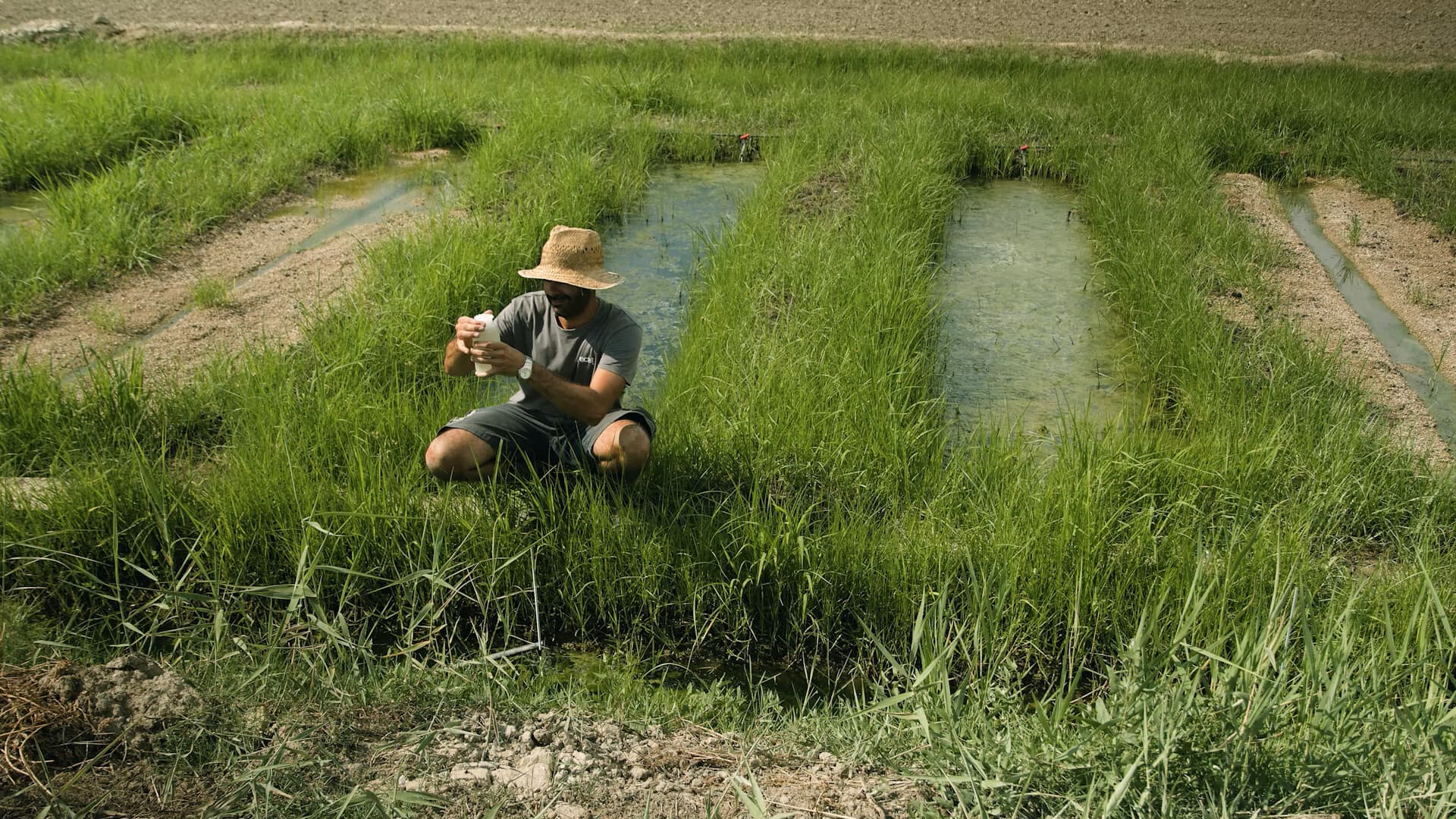
Here, they formed an artificial wetland at the end of the test field, called a cell. Just like in the wetlands, water flow slows down as it enters these cells, allowing the plants and soil to absorb a considerable amount of pollutants, and thus filtering a massive amount of water flowing through the test site.
The results: In the laboratory, the mixture of biochar and sand removed about 80-90% of contaminants.
Further analysis of these samples showed that these experimental mixtures could remove up to 60% of the most common fungicides and herbicides.
However, this result was achieved under controlled conditions in the lab. When researchers carried out the experiment in the open environment, it removed 30% less chemicals.
Nevertheless, the researchers are encouraged by these early, promising results which will now be verified in further real-world experiments.
If this solution proves successful, it would mean that each rice field could have a wetland cell before the water enters the drainage canal. This would remove at least 50-60% of pollutants that would otherwise enter the sea. It could also be used in other river deltas across Spain, or worldwide.
Although they cover only 6% of the earth’s surface, freshwater wetlands are home to around 40% of our planet’s wildlife, and act as the world’s largest carbon sink.
Read also: South African study shows how mushrooms can help clean up polluted rivers