Skip to content


By Will Mather, associate consultant environmental scientist at WSP
The Franklin-98 Living Shoreline Project on Florida’s Gulf Coast is taking a relatively new and more sustainable approach to a growing problem: Chronic coastal erosion and storm damage. Highway 98, which is located beside Apalachicola Bay and runs for six miles between Eastpoint and Yent Bayou, has required repeated – and costly – repairs after coastal storms. It’s also a vital hurricane evacuation route.
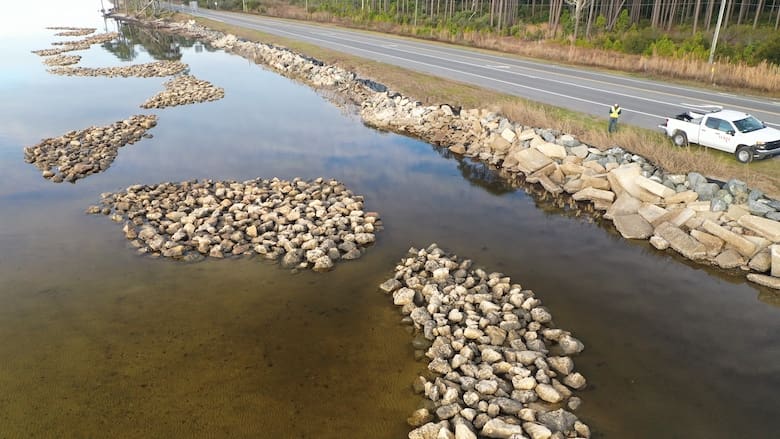
To protect it, this innovative $15.75 million project employs an innovative “living shorelines” approach, blending natural and engineered solutions to enhance resilience. It involves two main components, namely the creation of nearshore engineered artificial reef structures and the restoration of intertidal marsh habitat. Specifically, the project aims to:
- Establish 20 acres of engineered oyster reefs to absorb wave energy offshore. Crafted from limestone and recycled concrete, the reefs are designed to reduce the force of incoming waves by attenuating wave energy, creating a calmer environment near the shoreline and minimising erosion. These structures also are designed to serve as habitats for marine species, including oysters, which help filter and clean the water and enrich the local ecosystem.
- Restore 30 acres of salt marshes in the intertidal zone, the land closest to the shoreline that is periodically submerged and exposed as the tides change. The restoration of marsh vegetation closer to shore is intended to stabilise the coastline. These marsh plants help by capturing sediment, naturally rebuilding the shoreline. With the reduced wave energy provided by the reefs, the restored marshes are expected to thrive and form a natural buffer against storms.
Initially, the team considered traditional approaches like seawalls, which are less time-intensive and can have lower upfront costs. Yet, they require more maintenance and can have unintended negative consequences for local ecology. In contrast, the living shoreline project offers a longer-term solution that is self-repairing, requires less maintenance and supports ecological restoration.
The impacts so far are encouraging:
- Measurable sediment buildup has already been observed along the shoreline, even amid the aftermath of Hurricanes Helene and Milton last summer. As the storm surge retreated, the marsh grasses held the sediment in place, preventing it from being ripped away. Especially when compared to adjacent areas, which saw significant road shoulder damage, the protected areas behind the project sites held in place.
- This sediment buildup has also expanded the plantable zones for salt marshes, continuously amplifying the shoreline’s defence against future storms.
- Marine life has already begun populating the reef structures, producing ecological benefits. For example, oyster growth has already been seen on all of the reefs. This is particularly significant for Apalachicola Bay, once home to a thriving oyster industry until populations collapsed, resulting in 2020’s five-year moratorium on harvesting wild oysters. Teams hope that the project may help to revive oyster populations across Apalachicola Bay, further stabilising broader stretches of shoreline over time.
With Phase 1 of the project recently completed, two more construction phases are planned to cover the total six miles. Officials are already looking for more potential sites in the bay to extend protective measures. By protecting both people and ecosystems in the face of rising seas and intensifying storms, the Franklin-98 Living Shoreline Project offers a scalable, replicable model for climate resilience.