Skip to content



More than one in five countries now get at least 10% of their electricity directly from the sun — and at least one has already reached the 25% mark, according to data collated by research group Ember.
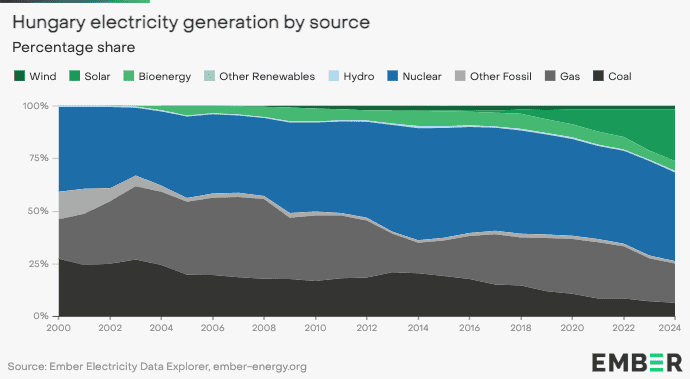
Thanks in part to its feed-in tariff scheme, Hungary is the world leader in solar PV integration, with the technology making up exactly a quarter of the nation’s total electricity generation in 2024 — up from just 2% as recently as 2018. Solar’s rise has come at coal’s expense: The dirtiest fossil fuel’s share of the mix fell from 15% to 6% over the same period, even as gas declined as well.
Chile, which is phasing out coal faster than any other developing nation, ranks second. There, solar’s share has climbed from 6% to 22% in just six years, in part due to the imposition of South America’s first carbon tax, which made renewables even more competitive than fossil fuels.
The likes of Luxembourg (22%), Greece and Spain (both 21%), Cyprus and Lithuania (19%), the Netherlands and Australia (18%), El Salvador (17%), and Germany and Portugal (15%) are close behind.
Australia ranks highest in terms of solar generation per person (1,866kWh), while China has, by far, the biggest fleet of solar panels on the planet (887GW as of end-2024).
Meanwhile, solar accounts for 32% of California’s electricity mix. This is particularly notable considering that the state would have the fifth-largest economy on the planet if it were a standalone country. Elsewhere, solar makes up 30% of both Nevada and South Australia’s power mixes.
And it’s early days yet. Solar will overtake coal to become the world’s biggest source of electricity within the next eight years (by 2033), according to the International Energy Agency’s projections.
Yes, but: In many cases, solar has advanced too quickly for grid operators to handle. From California to Hungary, authorities are rolling back support for the technology, which crowds other technologies out of the mix during the middle of the day and sends power prices plummeting, often into negative territory.
To cope with the flood of solar, the world’s electricity grids must become more flexible. This requires better interconnections with other countries, faster installations of batteries, dynamic pricing structures, and regulatory support for virtual power plants, among other things.
Read also: These countries are leading the way to 100% renewable electricity