Skip to content



Key facts: No evidence that renewables make power grids less reliable
- Global data does not support claims that renewables make grids prone to blackouts
- New research finds that infrastructure failures are the leading cause of blackouts globally
- Only one major recent incident was linked to power generators, but in that case, frozen equipment, particularly at gas-fired plants, was the main cause
- A report by Germany’s electricity network regulator shows that power availability to homes and businesses has increased over the years as the share of renewables has climbed
Critics of renewable energy often claim that these technologies are making the world’s electricity grids more vulnerable to power outages.
US President Donald Trump has said the decarbonisation measures required to meet the goals of the Paris Agreement would place the US “at grave risk of brownouts and blackouts,” and he’s since made several unprecedented moves to limit the growth of renewables.
In a similar vein, opponents of wind and solar energy have been quick to blame these technologies for major outages in recent years, including in South Australia, California, and Texas.
Most recently, many publications and pundits said the blackout that swept across Spain and Portugal in April 2025 was caused by an overreliance on clean technologies – particularly solar. The Daily Mail published an article by climate-sceptic Rupert Darwall, which said the incident showed “energy security is being sacrificed at the altar of green dogma.”
However, subsequent investigations have found the Iberian Peninsula blackout was caused by overvoltage, rather than renewable energy generators.
And global data doesn’t support the sceptics’ claims.
According to a new analysis by international research group Zero Carbon Analytics, infrastructure failures – including faults in transmission and distribution lines, as well as transformers – have been the leading cause of blackouts globally over the past two decades.
The group looked at 20 severe incidents since 2005 and found that infrastructure issues were responsible for at least half of them. Human error was the next most common contributing factor, followed by natural disasters and extreme weather events.
Only one incident – the Texan blackout during an intense winter storm in 2021 – was linked to power generators. In that case, frozen equipment, particularly at gas-fired plants, was the primary cause. (Since then, the state’s grid has become less prone to grid emergencies thanks to the rapid buildout of solar and battery storage facilities, according to Electric Reliability Council of Texas.)
Meanwhile, a new report by Germany’s electricity network regulator shows that power availability to homes and businesses has increased over the years – even as the share of renewables has climbed.
Power supply disruptions in the country averaged just 11.7 minutes in 2024, compared to 12.8 minutes the year before, and 21.5 minutes in 2006. This is despite renewables rising from 12% of the electricity generation mix in 2006 to 54% in 2023 and 58% in 2024.
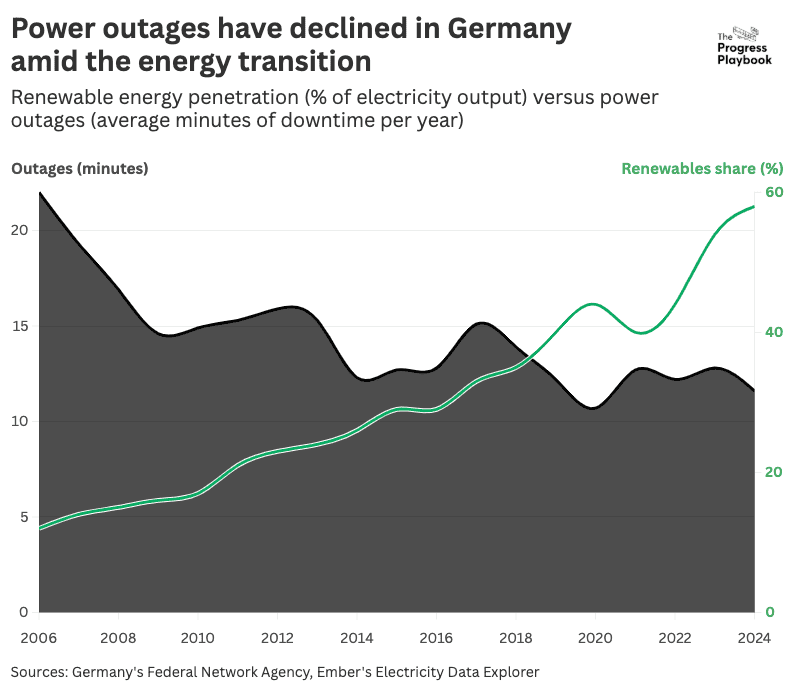
“The energy transition is progressing without any loss of secure electricity supply,” says Klaus Müller, president of the Federal Network Agency.
Germany benefits from strong power system interconnections with neighbouring countries, and these links help to maintain system reliability.
Nevertheless, the data shows that “renewables are not ‘inherently’ destabilising to a grid,” says Ember analyst Nicolas Fulghum. “The German power system has incredibly high reliability and it has become even more reliable over time.”
Fulghum adds that the country’s grid codes adequately allow wind and solar farms to provide critical services such as voltage control.
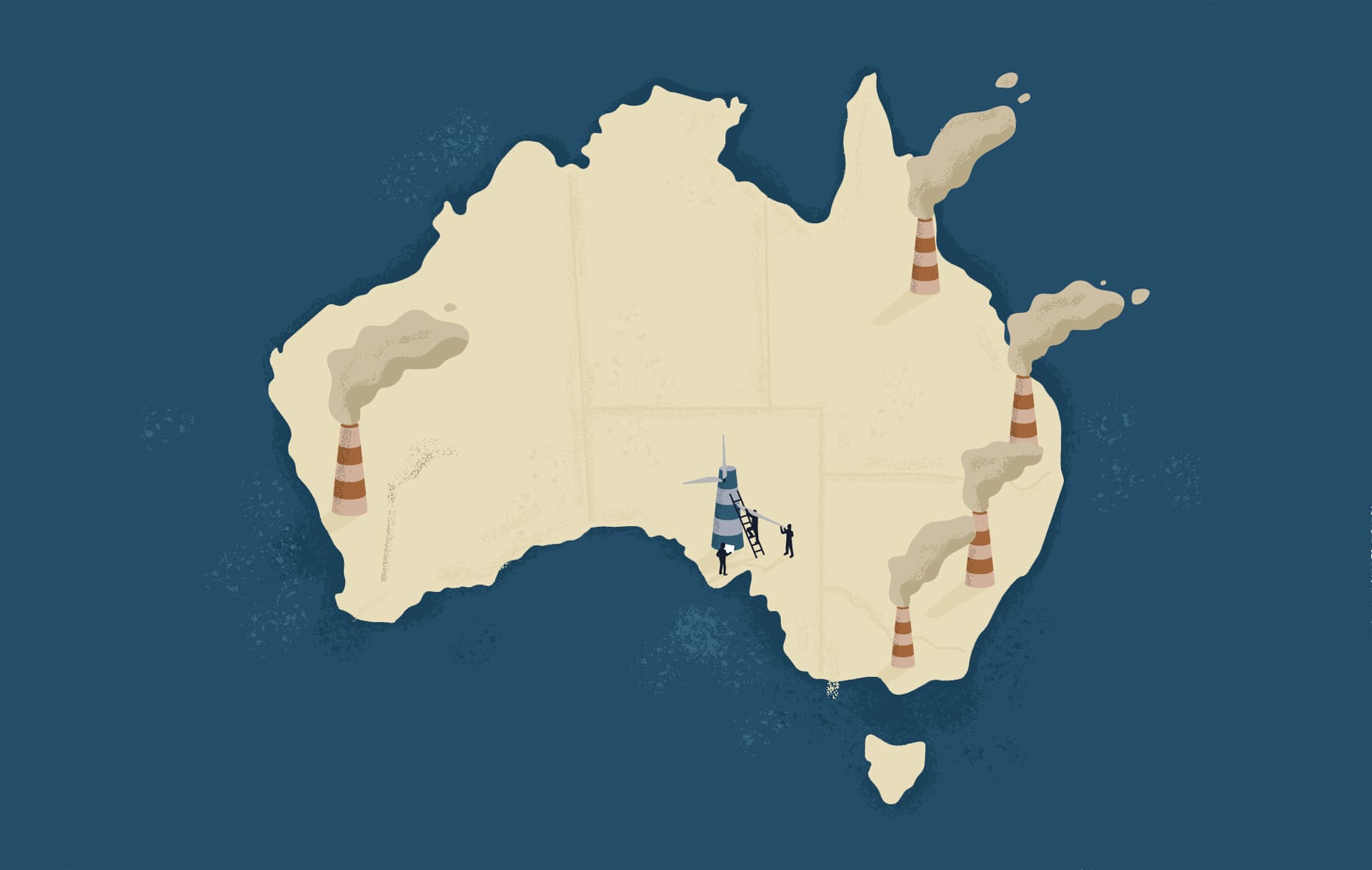
In more isolated markets like Australia, power outage warnings have been mainly caused by coal plant failures, according to a recent report by consulting group Baringa. The country’s energy market operator noted in a recent analysis that the ongoing renewable energy boom is improving the outlook for grid reliability.
Similarly, the UK’s energy system operator says the country will have the best electricity margins in six years this winter (in other words, supply will more comfortably exceed demand). That’s thanks in part to the rapid growth in battery storage installations, a new interconnection with Ireland, and rising output from wind farms (in September, wind and solar accounted for 50.4% of the UK’s power output, the highest monthly share on record, per Ember data).
Nevertheless, the world needs to vastly ramp up investments in electricity grids to accommodate renewable energy additions and maintain and improve reliability, analysts say. Domestic networks need to be rapidly expanded, and new interconnections and battery storage systems will also be required.
For the time being, however, the rate of investment is far short of what’s needed, according to the International Energy Agency.