Skip to content


The world’s growing fleet of electric vehicles is starting to meaningfully curb oil demand, new data from the International Energy Agency (IEA) shows.
In 2024, the global stock of electric cars displaced over 1 million barrels per day of oil consumption, according to the agency. That equates to roughly 1% of total demand for oil, which is also used to make plastics and a wide range of every-day products and fuels.
As the share of EVs in new car sales grows — from roughly 20% last year, to 25% in 2025, and a projected 40% in 2030 — the total fleet will swell and make an increasingly large dent in oil use.
By 2030, EVs will displace more than 5 million barrels of oil per day (equivalent to a nearly 5% reduction in total demand), with China responsible for half that amount.
Electric models already account for close to 60% of new car sales in China, and that share is expected to reach 80% by the end of the decade thanks in part to government incentives that encourage people to trade in fuel-guzzling cars for EVs. Moreover, two-thirds of electric cars sold in China in 2024 were already cheaper than their conventional equivalents, even without incentives.
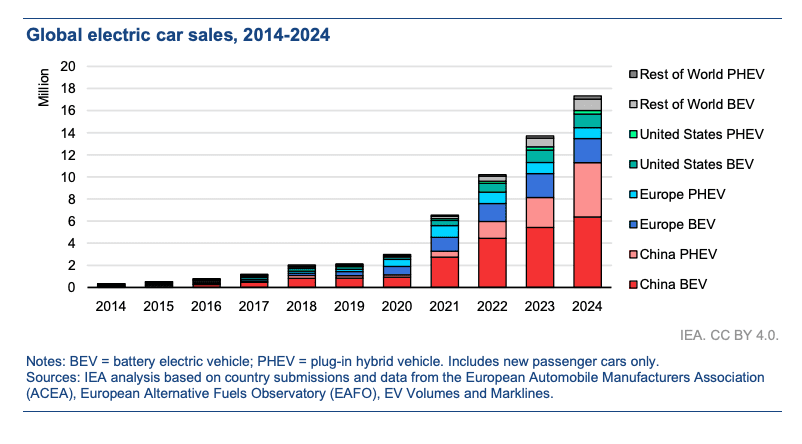
Yes, but: While the US was previously expected to catch up with the global average, president Donald Trump’s efforts to stymie the shift will see EVs reaching a mere 20% market share in the world’s biggest economy in 2030 (versus over 40% worldwide), per the IEA’s revised forecasts.
And it’ll take a long time to fully phase out the internal combustion engine cars already in use. Despite the country’s EV sales surge, only one in 10 cars on China’s roads is electric.
Further, road transport accounts for slightly less than half of global oil demand, meaning aviation, shipping, plastics and other products will continue to prop up oil demand until non-fossil alternatives are deployed at scale.
As a result, oil demand could edge slightly higher still. The IEA thinks consumption will likely plateau at around 106 million barrels per day in the years ahead.