 Skip to content



Wildlife crossings — which allow animals to safely pass under or over highways — are growing increasingly common in some parts of the world. That’s a win for conservation efforts, recent studies show.
Why it matters: Highways and other types of infrastructure can be a death trap for animals on the move. According to some estimates, billions of vertebrates are killed on the world’s roads each year. Along with their impact on migration patterns, access to breeding grounds, and habitat connectivity, freeways are exacerbating the biodiversity crisis. Further, collisions with large animals are often deadly for humans too.
The background: France and the Netherlands were early pioneers of wildlife crossings, which usually take the form of bridges, underpasses, and viaducts. The concept has since taken hold in other parts of the world, including Australia and the Americas, where momentum is building.
In Canada’s Banff National Park, for example, 44 structures were built between 1996 and 2016, and this contributed to an 80% reduction in motor accidents involving wildlife.
The latest: The largest wildlife bridge in the world, in California’s Santa Monica Mountains, is nearing completion. Spanning 10 lanes of the US Highway 101 freeway, it’ll host about 5,000 native plants and help safeguard mountain lions, deer, bobcats, and other animals.
“We’re one step closer to reconnecting wildlife with habitat that’s been divided for generations,” state governor Gavin Newson said in a statement. “We’re not only making habitats whole again, we’re making our roads safer.”
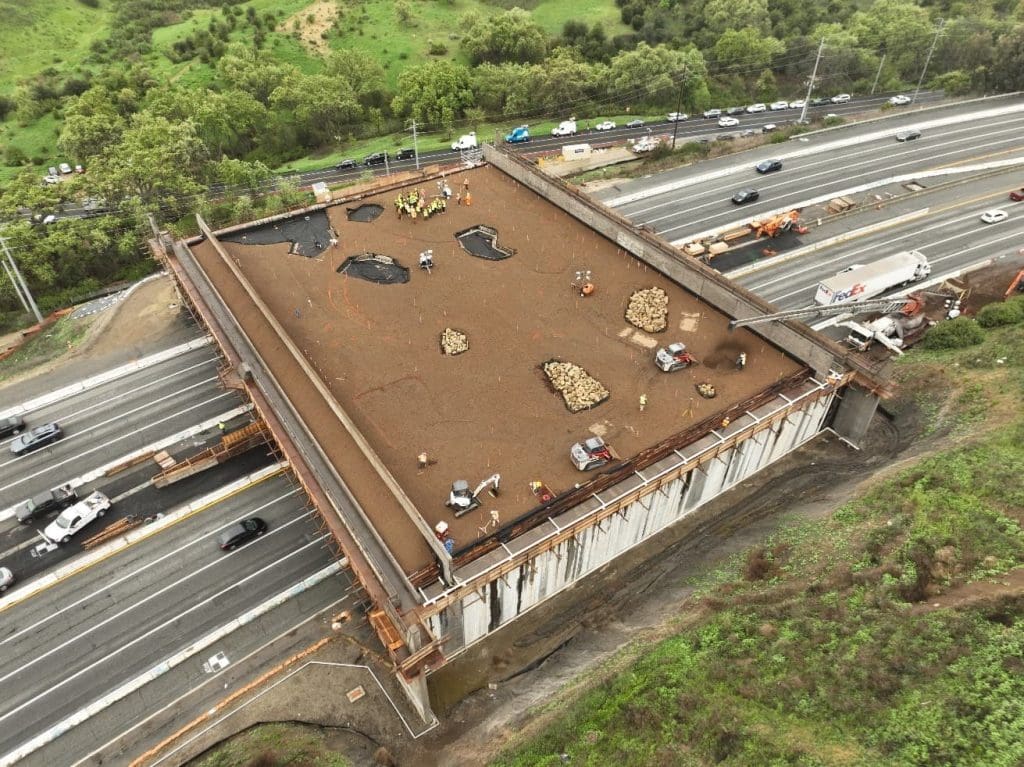
In late December, the US Federal Highway Administration awarded the first grants under a $125 million wildlife crossings pilot programme. Under one of the winning projects in North Carolina, a 2.5-mile section of highway will be rebuilt with fencing and a series of small underpasses to allow red wolves, bears, deer and other animals to safely pass below cars. (The future of this pilot programme is in doubt amid the Trump presidency’s sweeping budget cuts, especially for programmes with environmental benefits.)
The impact: Numerous studies show that wildlife crossings are highly effective — though some do a better job than others.
When combined with associated infrastructure like fencing, they can yield an 83% reduction in the road deaths of large mammals, according to a peer-reviews study by Canadian, Australian and European researchers, who found that fencing is critical as it shepherds animals to the crossings.
Another study found that viaducts — which allow animals to pass under roads — are the most effective type of wildlife crossing for large mammals. The odds of hoofed mammals crossing through a viaduct are 2.9 times that of an overpass, the 2021 meta-analysis found.
In Colorado, officials have built 40 wildlife underpasses and three overpasses, with notable results. In most cases, car crashes involving animals have declined by 90%.
Looking ahead: Planners will increasingly need to factor climate change into their wildlife-crossing strategies, a recent study found.
“Examining where animals are moving today and predicting where they may move under changing climatic conditions and land use can indicate potential crossing locations that support wildlife now and into the future,” the study reads.





2 Responses
Hi, I run CREN (Community Radio Environment Network) and am very interested in creating a short daily planetary index bulletin for community radio news, with news on statistics, events and solutions/positive developments. Right now I’m compiling lists of useful sources and people. If you have any thoughts on what such a bulletin should consist of please do get in touch! Many thanks!
Hi Penny, thanks for the message. Please email [email protected]. Thanks!